


Umrah for the First Time: A Step-by-Step Guide for 2026/27
Umrah in the 2026/27 season needs four things: a visa (a tourist eVisa, which allows Umrah, or an Umrah visa through a licensed agency), a free Umrah permit booked in the Nusuk app, a meningitis ACWY vaccine certificate, and a Nusuk slot for the Rawdah in Medina. The rites take a few hours: ihram before the miqat, seven circuits of tawaf, sa'i between Safa and Marwa, then cutting the hair.
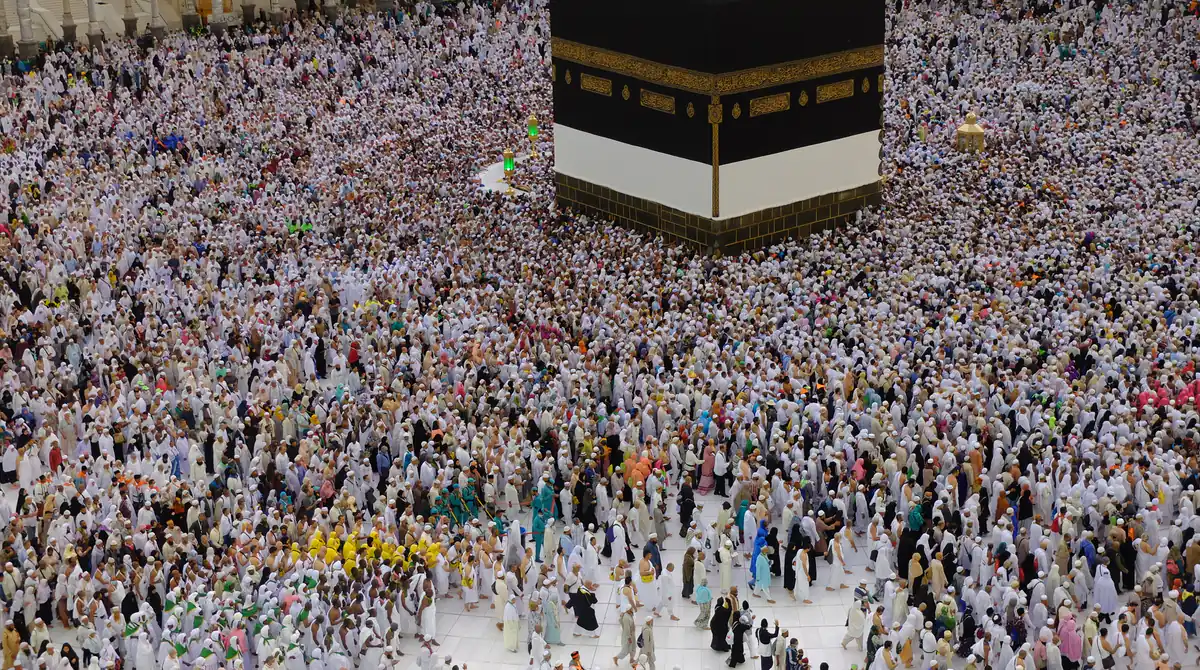
Nobody forgets their first sight of the Kaaba, and almost everybody remembers something they wish they had known beforehand: that the permit lives in an app, that the walk from the hotel is longer than the brochure said, that the vaccine certificate is checked, that sandals matter more than any other item in the suitcase. This guide puts the practical side of Umrah in order for the 2026/27 season, step by step, so the spiritual side gets your full attention.
When you can go: the 2026/27 Umrah season
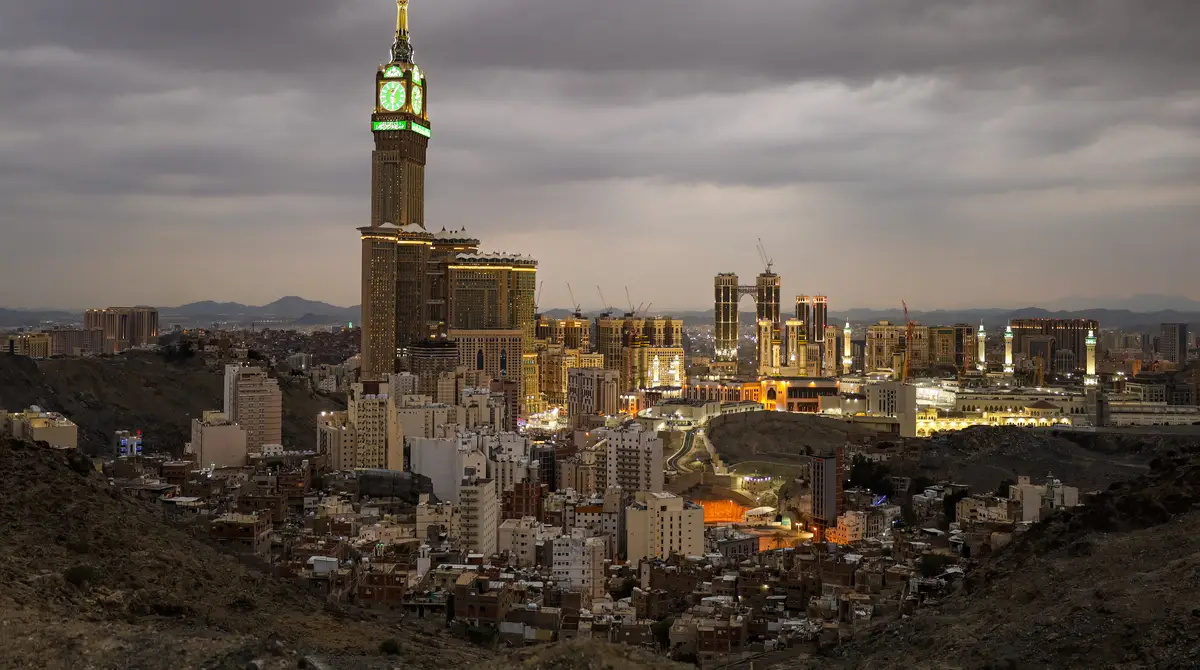
Umrah can be performed all year except during the Hajj weeks, when Saudi Arabia pauses visas and permits. The current season opened at the end of May 2026 and the published calendar closes it in spring: the last Umrah visa is issued on 9 March 2027, the last entry on an Umrah visa is 23 March 2027, and all Umrah visa holders must leave by 7 April 2027. Ramadan is expected to begin around 8 February 2027 and end in the second week of March; it is the most crowded and the most expensive month, and for many people the most moving one. October to February is the comfortable window: daytime temperatures in Mecca sit in the twenties and low thirties, Medina evenings can be cool enough for a jacket.
The visa: three roads to the same door
- Tourist eVisa: issued online at the official Saudi eVisa portal for citizens of about seventy countries, including most of Europe, the UK, the US, Albania and, since October 2026, Kosovo. It costs roughly 535 riyals including the mandatory insurance (about EUR 125), is valid for a year with multiple entries and up to 90 days in total, and explicitly allows Umrah outside the Hajj season. Passports need six months of validity.
- Umrah visa through a licensed agency: the classic route for groups. Since the 2025/26 rules, the agency must have confirmed Nusuk-approved hotel and transport bookings before the visa can be issued, which is why agencies sell complete packages rather than visas alone. A standard Umrah visa must be used within 30 days of issue; multiple-entry versions valid for a year also exist.
- Other valid visas: transit, visit and work visas are generally accepted for Umrah outside the Hajj season. Hajj itself always needs its own dedicated visa and is never covered by a tourist visa.
Nusuk permits and the vaccine certificate
The visa gets you into the country. The Nusuk app gets you to the Kaaba. Every pilgrim, whatever the visa, needs a free Umrah permit booked in Nusuk for a specific time slot; without it you are not admitted to the mataf, the open area around the Kaaba. Groups usually have their operator book collectively, but it is wise to have your own account anyway, because the same app issues the permit for the Rawdah in the Prophet's Mosque in Medina, where slots run out days ahead in busy periods. Book the Rawdah the moment your dates are fixed.
The health requirement is a quadrivalent meningococcal vaccine (ACWY) for everyone aged one and above, given at least ten days before arrival and documented on a certificate that is not older than three years (five for the newer conjugate vaccine, which your doctor can confirm). Carry the paper copy with the passport; it is checked for the Umrah visa and can be asked for on arrival. Polio and yellow fever rules apply only to travelers from countries where those diseases are present.
Getting there: Jeddah or Medina
Two airports serve the pilgrimage. Jeddah is the big one, an hour by road or about an hour by the Haramain high-speed train from the airport's own station to Mecca. Medina's airport sits beside the second holy city, and starting there has a practical advantage: you visit the Prophet's Mosque first, rest from the flight, then enter ihram at the Medina miqat on the way to Mecca by train or bus, without the stress of ihram on the plane. The Haramain train links Medina and Mecca in roughly two and a half hours; tickets, booked online, run from around 45 to 100 euros depending on class and date. Both airport SIM counters fill with entire groups arriving at once, which is why most pilgrims now install an eSIM before they fly; more on that below.
Ihram: what to do before you cross the miqat
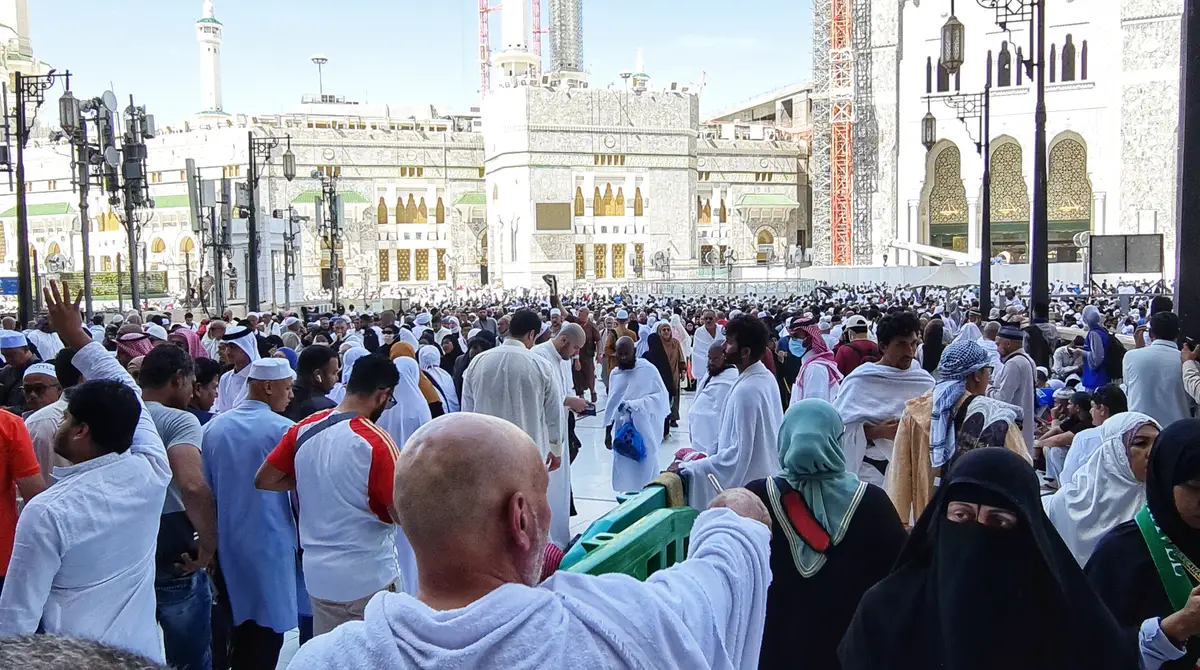
Ihram is a state, not only an outfit. You enter it before crossing the miqat, the boundary around Mecca, with the intention for Umrah and the talbiyah. Flying into Jeddah from Europe, the plane crosses the miqat in the air, usually announced by the crew about half an hour before landing, so men put on the two white unstitched cloths before boarding or during a stopover, and everyone makes the intention when the announcement comes. Coming from Medina, you stop at the Dhul Hulayfah miqat on the edge of the city. Women wear ordinary modest clothing, with the face and hands uncovered. From that moment until the hair is cut: no perfume, no cutting nails or hair, no stitched clothing or covered head for men, no arguments, no marital relations. Scented soap and wipes stay in the suitcase; unscented ones are sold everywhere.
The rites, step by step
Tawaf: seven circuits of the Kaaba
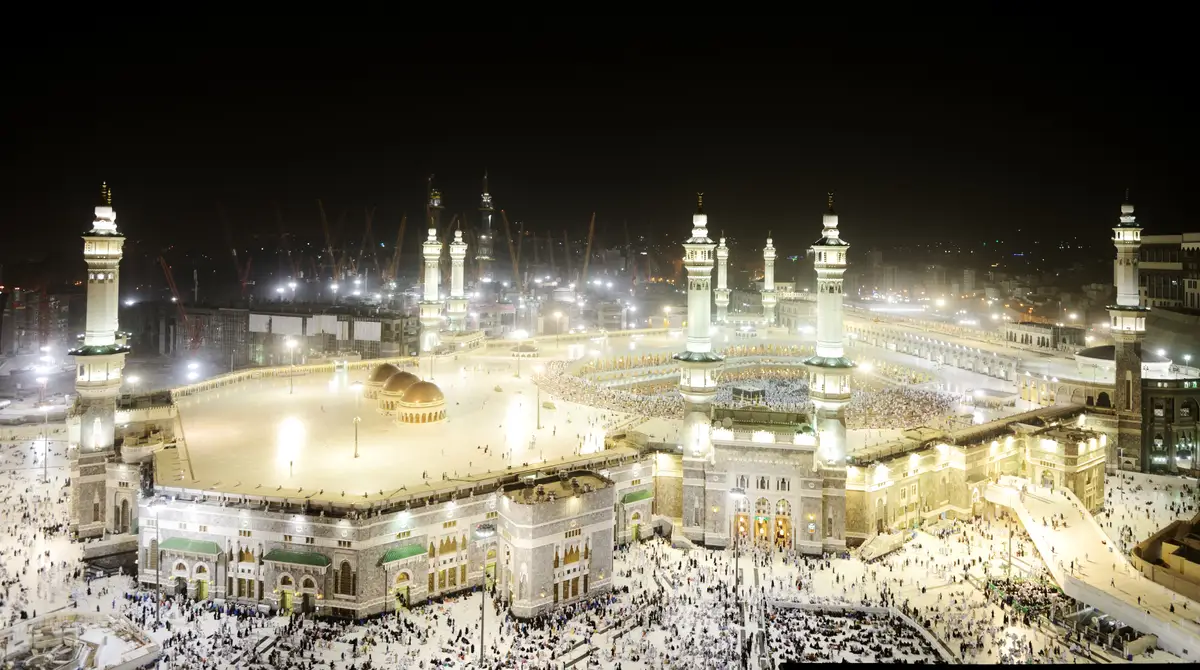
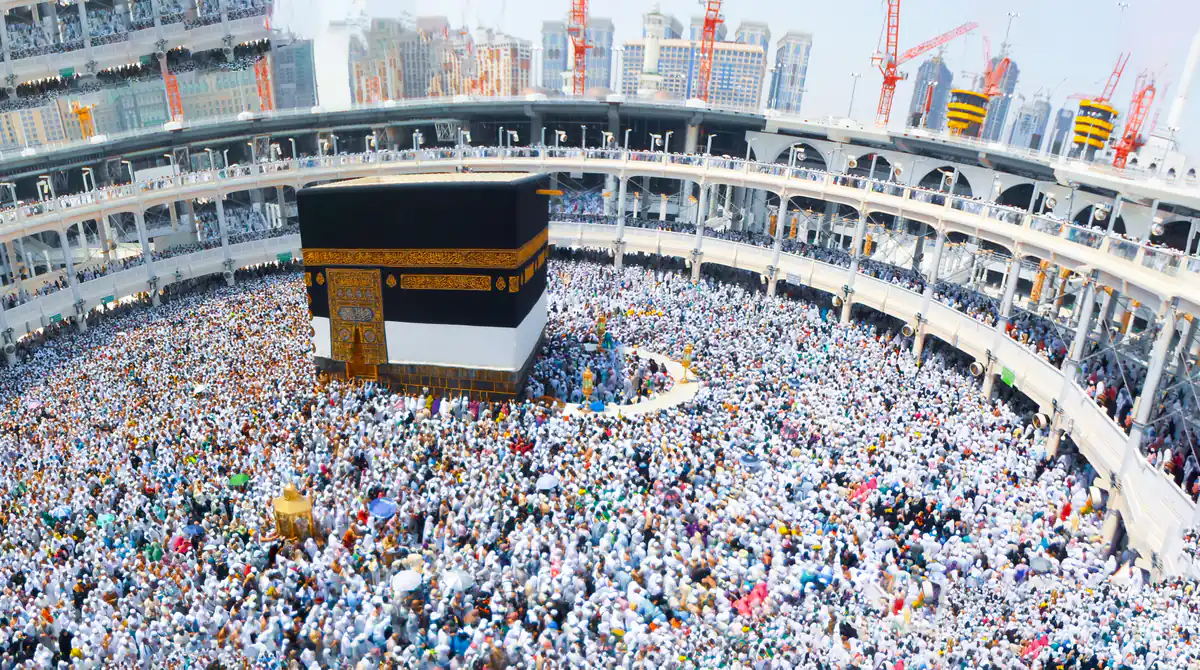
Enter the Grand Mosque with the right foot and the prayer of entry, and when you see the Kaaba, pause: many pilgrims make a quiet du'a here. Tawaf begins at the line of the Black Stone, with the Kaaba on your left, and goes round seven times counterclockwise. Men uncover the right shoulder for the tawaf of Umrah and walk briskly in the first three rounds if the crowd allows. Touching or kissing the Black Stone is a sunnah, not an obligation; pointing toward it from a distance at each round is enough and far kinder in a crowd. After the seventh circuit, pray two rak'ahs behind the Station of Ibrahim or anywhere in the mosque, then drink Zamzam from the coolers that line every corridor.
Sa'i: between Safa and Marwa
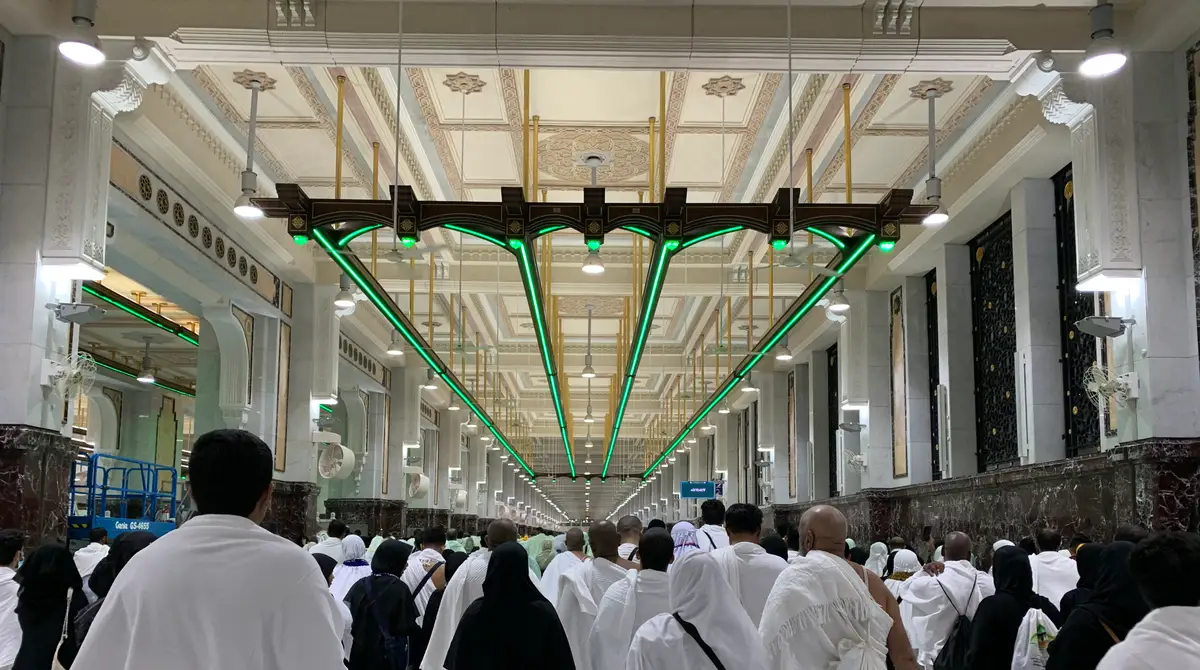
Sa'i is the walk between the hills of Safa and Marwa inside the mosque, seven lengths, starting at Safa and ending at Marwa, so that each direction counts as one. Men quicken their pace between the green lights; women walk normally. The corridor is air-conditioned and long, about 450 metres each way, and the full sa'i takes most people forty minutes to an hour. Wheelchairs and electric carts are available for those who need them, with the carts on the upper levels.
Halq or taqsir: leaving ihram
Umrah ends with cutting the hair. Men shave the head or shorten all of it; shaving is considered the better of the two. Women cut a fingertip's length from the ends. Barbers sit a few steps from the Marwa exit and work in minutes. With that, ihram is over: perfume, normal clothes and a long shower are all allowed again, and the rest of the stay belongs to prayer in the Haram, rest and the visits around the city.
Medina: the Prophet's Mosque and beyond
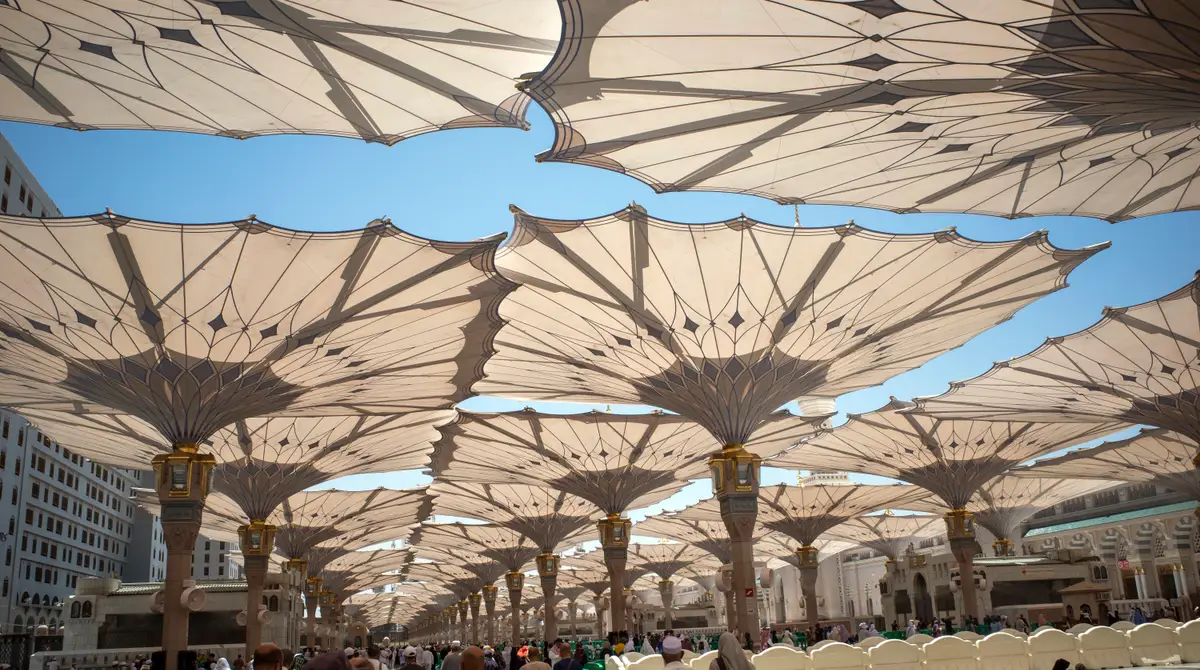
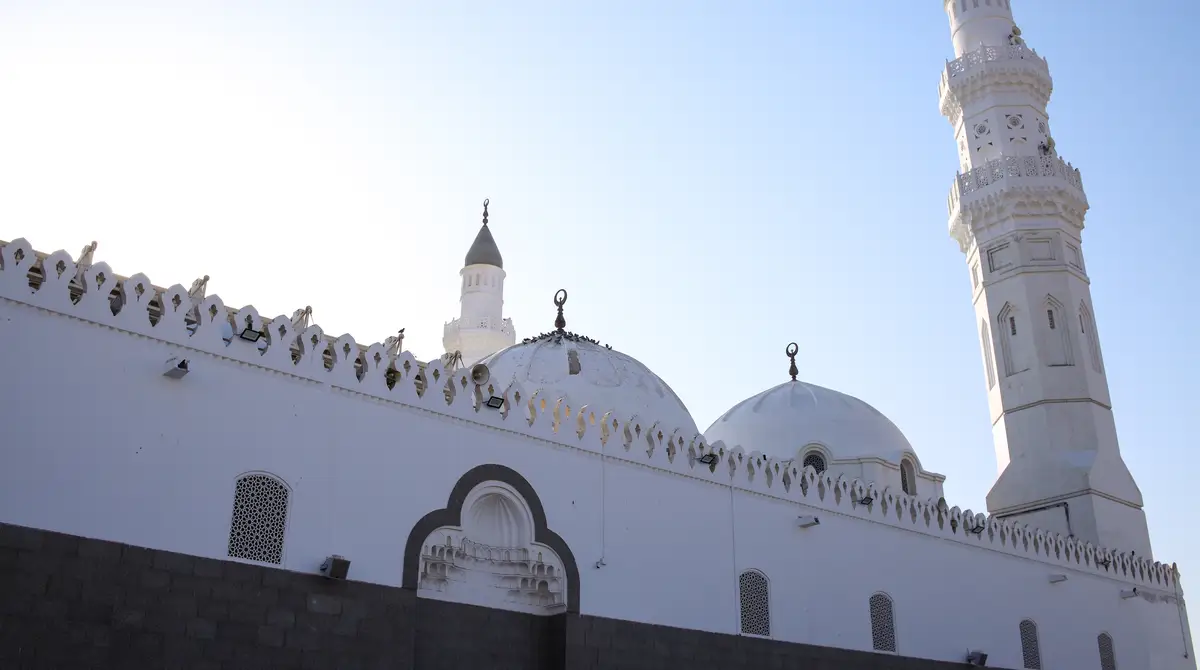
Medina is calmer than Mecca in every way: wider streets, a gentler pace, and a mosque whose courtyard umbrellas open each morning like flowers. There is no Umrah to perform here, only prayer, the greeting at the Prophet's grave and, with a Nusuk slot, a short time in the Rawdah, the small area between the minbar and the grave. Outside the mosque, the visits most groups make are Quba, the first mosque in Islam, where two rak'ahs are rewarded like an Umrah according to the hadith, the Qiblatayn mosque, and Mount Uhud with the graves of the martyrs. Three nights is enough for the essentials; four or five lets you breathe.
Money, weather and what to pack
- The currency is the Saudi riyal, roughly 4.3 riyals to the euro. Cards and contactless payment work in hotels, restaurants, pharmacies and most shops; keep some cash for taxis, barbers and the small stalls around the Haram.
- Sandals that leave the ankle free, worn in for a week before the trip. You will walk more than you expect, on marble, often in the heat.
- Two sets of ihram for men (one gets wet, one gets dirty), a belt with pockets for passport and phone, a small bag for the shoes inside the mosque, unscented soap, a folding prayer mat for the courtyard.
- Medication in its original packaging with a copy of the prescription; pharmacies are excellent but your usual brand may not exist.
- A power bank. Maps, the permit app and the heat drain a phone by mid-afternoon.
- Zamzam to take home is sold in sealed five-litre bottles at the airports; most airlines carry one per passenger in the hold. Do not try to pack your own bottles.
- Winter trips: a light jacket for Medina evenings. Summer trips: a cap or umbrella for the walk, and plan the Haram for after sunset.
Your phone in the holy cities
Pilgrimage runs on a phone now. The Umrah permit and the Rawdah slot are shown from the Nusuk app, the group keeps together on chat, the blue dot on the map brings you back to the hotel at three in the morning, and the family at home waits for a video call from the courtyard. Hotel Wi-Fi shared by several hundred guests does not carry that, and a local SIM means passport registration at a counter where your whole flight is queuing. The simple fix is a Saudi Arabia eSIM installed at home over Wi-Fi: it connects when the plane lands, and the 60-day validity of the larger plans covers even a long stay. Kudo's plans start at EUR 2.99 for 1 GB; 3 GB for EUR 7.99 covers a week of maps, Nusuk and chat, and 5 GB for EUR 10.99 or 10 GB for EUR 18.99 are the right size for daily video calls home.
Saudi Arabia eSIM for Umrah
Install it at home, it connects when you land. Plans from EUR 2.99, up to 20 GB valid 60 days.
See the plansSmall things first-timers learn the hard way
- Perform the Umrah on arrival night or very early in the morning. The mataf is noticeably emptier between midnight and dawn prayer.
- Agree a meeting point outside each gate before entering. Phones lose signal in the densest crowds and groups separate at the shoe racks.
- Photograph the gate number you entered by. The mosque has over a hundred gates and they look alike after dark.
- Hydrate with Zamzam constantly; it is free, cold and everywhere inside. Heat exhaustion is the most common reason pilgrims end up in the clinics.
- Keep the hotel card with the address in Arabic in your pocket for taxis.
- Friday noon prayer fills the Haram hours in advance; be inside by late morning or pray in a nearby mosque.
- Leave room in the suitcase. Dates from Medina and prayer beads for everyone at home weigh more than you think.
Frequently asked questions
Can I perform Umrah on a tourist visa?
Yes. The Saudi tourist eVisa explicitly allows Umrah outside the Hajj season. It is available online to citizens of about seventy countries, costs roughly 535 riyals including insurance, is valid for a year with multiple entries and up to 90 days in total. You still need the free Umrah permit from the Nusuk app.
Is the Nusuk permit really mandatory?
Yes, for every pilgrim and every visa type. The permit is free and tied to a time slot; without it you are not admitted to the area around the Kaaba. The same app issues the permit for the Rawdah in Medina, which should be booked as soon as your dates are fixed.
Which vaccine do I need for Umrah?
The quadrivalent meningococcal vaccine (ACWY), for everyone aged one and older, given at least ten days before arrival and documented on a certificate not older than three years (five for the conjugate type). Carry the paper certificate with your passport.
How long does Umrah itself take?
The rites take two to four hours depending on the crowd: tawaf of seven circuits, two rak'ahs, sa'i of seven lengths between Safa and Marwa, then cutting the hair. Most pilgrims complete them on arrival night and spend the remaining days in prayer and visits.
When is the best time for Umrah?
October to February for weather and prices, with temperatures in the twenties and lower hotel rates. Ramadan, expected from about 8 February to 9 March 2027, is the most rewarding and the most crowded and expensive period. The season closes for Hajj in spring; the last Umrah visa of this season is issued on 9 March 2027.
How do I stay online in Mecca and Medina?
Install a Saudi Arabia eSIM at home before flying. It connects automatically on landing, with no passport registration at the airport counter. Kudo's plans start at EUR 2.99; 3 GB for EUR 7.99 is valid 60 days and covers Nusuk, maps and group chat for a typical Umrah.